
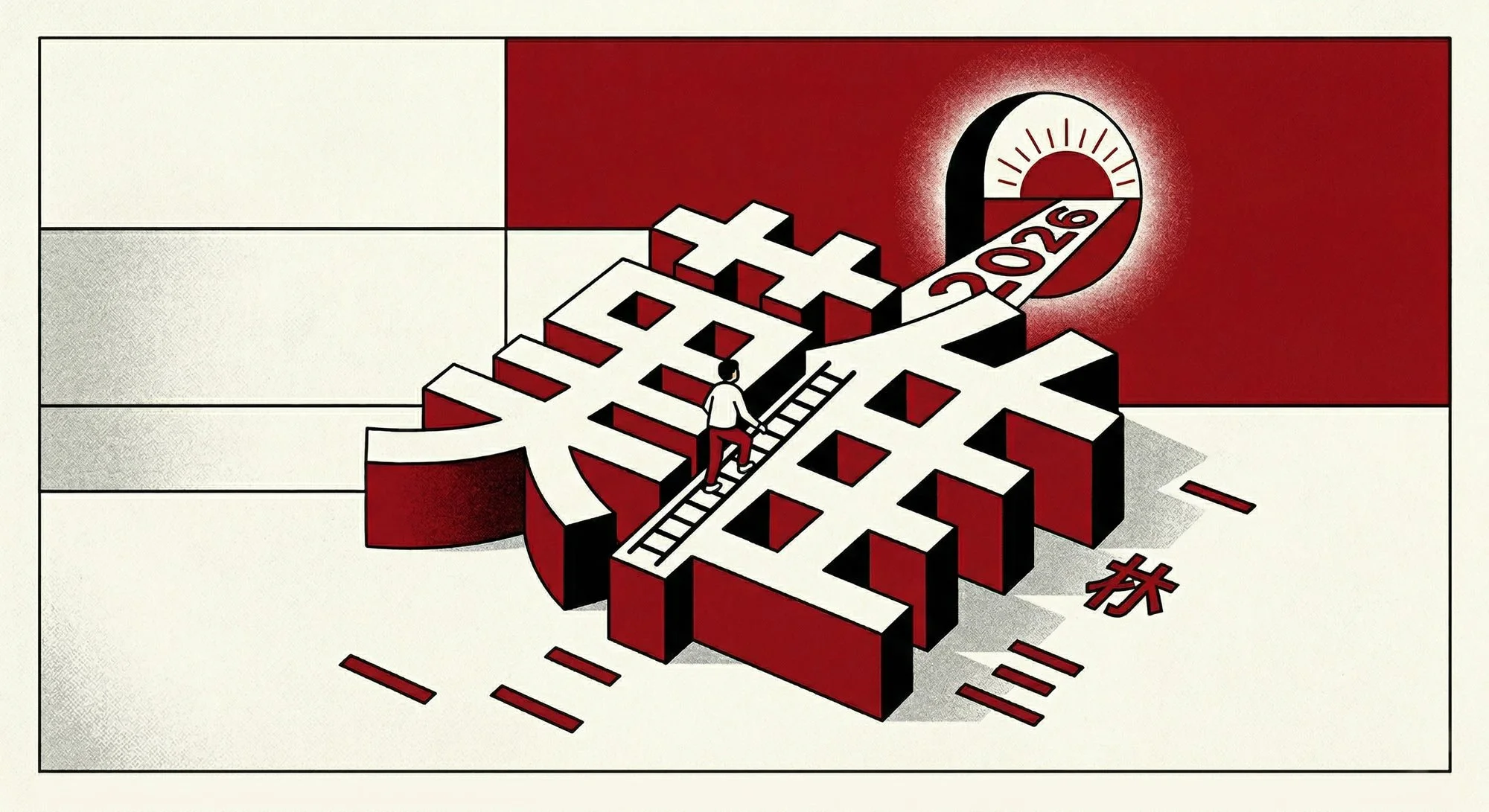
Is Japanese Hard to Learn for English Speakers? The Honest Answer (2026)
Honestly? Yes.
Anyone who tells you otherwise is trying to sell you an app.
But before you close this tab and go back to Duolingo's 5-minute daily streak of learning how to say "the apple is red," let us offer some important context.
Japanese is hard in specific, predictable ways. Once you understand what those ways are — and what's actually much easier than you expect — you can stop fearing the mountain and start working out which path to climb it.
What the Research Says
The Foreign Service Institute (FSI) trains US government employees to work in foreign languages.
Based on decades of data, they classify languages by difficulty for native English speakers.
Japanese sits in Category IV — the hardest category, alongside Arabic, Mandarin, Cantonese and Korean.
The FSI estimates approximately 2,200 classroom hours to reach professional working proficiency in Japanese.
For comparison, French and Spanish sit at Category I, requiring around 600–750 hours.
Before you spiral: professional working proficiency is a very high bar. Most people don't need to negotiate a trade agreement or write legal briefs in Japanese. They want to travel, watch anime without subtitles, speak to a partner's family, or pass the JLPT N3. Those goals are achievable in a fraction of 2,200 hours.
The Actual Hard Parts of Japanese
Let's be honest about what will challenge you.
1. Three Writing Systems
Japanese uses three scripts simultaneously.
Not interchangeably — simultaneously.
A single sentence can contain all three.
Hiragana (ひらがな) — A phonetic alphabet of 46 characters for native Japanese words and grammar.
This is where every learner starts and it can genuinely be learned in 2–4 weeks with consistent practice.
Katakana (カタカナ) — A second phonetic alphabet, also 46 characters, used for foreign loanwords, emphasis, and certain technical terms.
If hiragana is handwriting, katakana is block capitals.
Learn hiragana first; katakana follows quickly once you know the sounds.
Kanji (漢字) — Chinese-derived characters, each carrying meaning.
There are 2,136 everyday-use kanji in Japanese.
The average Japanese newspaper uses around 2,000.
JLPT N5 requires 100. N1 requires 2,000.
The writing system is genuinely the biggest barrier for English speakers.
It takes sustained, long-term effort.
There's no shortcut. But it's also systematic — kanji has logic, patterns, and components (called radicals) that make memorisation more manageable than pure rote learning.
2. Sentence Structure
Japanese is a Subject-Object-Verb language. English is Subject-Verb-Object.
In English: "I eat sushi."
In Japanese: "I sushi eat." (わたしはすしをたべます)
This seems trivial until you try to construct longer sentences and realise that the verb — which in English signals what's happening early in the sentence — is sitting at the very end in Japanese, making you hold the entire sentence in your head before you know how it resolves.
It takes time to rewire. It does rewire, with practice.
3. Politeness Levels
Japanese has multiple speech registers — formal, informal, humble, and honorific — and using the wrong one carries social consequences. You would speak differently to your boss, your friend, a stranger, and the Emperor (although admittedly, the Emperor is a niche use case for most Australian learners).
This sounds daunting, but in practice, as a foreign learner, you get enormous latitude.
Japanese people are genuinely delighted when non-Japanese people speak Japanese at all.
Your teacher will start you on polite/formal Japanese, which is appropriate for most situations, and nuance comes with time.
4. Counters
Japanese has specific counting words depending on what you're counting.
Long thin objects use one counter. Flat objects use another.
Small animals, large animals, bound volumes, mechanical devices — all different counters. There are dozens of them.
Is this annoying? Yes. Most learners memorise the most common counters, approximate the rest, and carry on.
Native Japanese speakers don't always agree on the correct counter for unusual objects either.
5. Kanji Readings
Most kanji have multiple readings depending on context — an on-reading (derived from Chinese) and a kun-reading (native Japanese).
The kanji 日, for example, can be read as nichi, jitsu, hi, ka, or bi depending on where it appears. This is not a typo.
This is real, it is confusing, and it takes time to internalise.
Start with context — learn kanji in words rather than in isolation, and the readings start to feel more natural.
The Easy Parts Nobody Tells You About
This is the part most guides skip, because "Japanese is terrifying" makes for better content than "actually pronunciation is fine." But the genuinely manageable parts of Japanese deserve credit.
Pronunciation Is Straightforward
Japanese phonetics are far simpler than English.
There are five vowel sounds: a, i, u, e, o — pronounced consistently, always the same way, every time. There are no tones (unlike Mandarin). There are no sounds that require entirely new mouth positions (unlike Arabic).
Most Australian learners produce comprehensible Japanese pronunciation within their first few lessons.
The tricky bits: the "r" sound (somewhere between r and l, made with the tongue flicking forward rather than curling back), long vowels, and double consonants. These are learnable. The foundations are easy.
Verb Conjugation Is Simpler Than European Languages
Japanese verbs don't change based on subject. There is no equivalent of conjugating "to be" across I am, you are, he is, we are, they are.
A verb in Japanese changes based on tense and politeness level — not based on who's doing it.
After French or Spanish verb tables, this feels like a gift.
No Gender
Japanese nouns have no grammatical gender.
There is no masculine or feminine article. The exhausting French "le/la" problem does not exist.
A table is just a table.
No Plurals
Japanese nouns don't generally change form for plurals.
猫 (*neko*) means cat and also cats. Context handles the distinction.
This is one less thing to think about.
The Logic Is Consistent
Unlike English — which is essentially several languages that had a traffic accident and then argued about spelling for five hundred years — Japanese grammar is remarkably consistent. Rules apply reliably. Once you understand a pattern, it works. There are exceptions, as in any language, but the foundations are logical in a way that rewards study.
Is Japanese Hard for Mandarin or Chinese Speakers?
Significantly less hard, though "not hard" would still be overstating it.
If you read Chinese, you already recognise a large number of kanji — the characters were adopted from Chinese, and many meanings align.
The vocabulary overlap is real. This represents a genuine head start on what is otherwise the most time-consuming aspect of Japanese for English speakers.
The complication: kanji readings in Japanese are different from Chinese pronunciations, and Japanese grammar structure differs significantly from Mandarin. The shortcut exists but it's not a bypass — it's a head start.
At Japanese Australia, many of our Sydney, Melbourne and Singapore students come from Chinese-speaking backgrounds and find the kanji component more accessible than their classmates. Grammar still takes dedicated work regardless of background.
Is Japanese Harder Than Korean?
Different hard, roughly similar difficulty overall.
Both sit in the FSI's Category IV.
Korean also has a Subject-Object-Verb structure, politeness levels, and a distinct writing system.
Its writing system (Hangul) is phonetic and can be learned in days rather than weeks, giving Korean learners a faster initial start.
But Korean has no Chinese character overlap, so vocabulary building from scratch is required.
For Australian learners, the honest answer is: if you're choosing between Japanese and Korean purely based on difficulty, flip a coin.
Choose based on what you actually want to do with it.
How Long Will It Actually Take You?
This is what most people really want to know.
| Goal | Time (consistent study) |
|---|---|
| Basic travel survival Japanese | 8–12 weeks |
| Hold simple conversations | 6–12 months |
| Pass JLPT N5 | 3–6 months |
| Pass JLPT N3 | 12–18 months |
| Watch anime without subtitles | 2–3 years |
| Pass JLPT N1 | 3–5 years |
| Read a novel | 4–6 years |
"Consistent study" here means structured lessons plus daily practice — vocabulary review, listening exposure, reading.
Two structured lessons per week with 20–30 minutes of daily practice is a realistic schedule for most working adults and produces real results.
The people who succeed in Japanese are not necessarily the people who are most talented at languages.
They're the people who show up consistently.
The mountain is climbable.
It just takes longer than you think, which means the best time to start is now.
The Verdict
Japanese is genuinely challenging for English speakers.
The writing system is a real commitment.
The sentence structure requires rewiring.
The vocabulary shares almost nothing with English.
And it is also one of the most rewarding languages an English speaker can learn — because the effort is visible, the milestones are real, and the culture you're accessing is extraordinary.
The question isn't really whether Japanese is hard.
You know it is.
The question is whether it's hard in a way that's worth it to you.
For most people who ask, the answer turns out to be yes.
Start Learning Japanese With Native Japanese Teachers
At Japanese Australia, all lessons run live online via Zoom with qualified native Japanese teachers.
We teach the direct method — lessons conducted predominantly in Japanese from day one — which builds real fluency faster than translation-based approaches.
Why Learn Japanese in 2026?
Japan and Australia have never been more connected. The Japan-Australia Economic Partnership Agreement, growing tourism flows in both directions, Japanese investment in Australian resources and agriculture, and a new generation of Australians growing up with Japanese pop culture have all deepened the relationship.
At the same time, Japan is in the middle of a sustained period of international engagement — hosting millions of visitors, welcoming foreign workers in record numbers, and positioning itself as a global hub for technology and innovation.
The demand for Japanese language skills in Australia is real and growing. Whether your motivation is cultural, professional, personal or a long-planned trip — there has never been a better time to start.
How to Enrol in Japanese Australia
Ready to start? Here's how it works:
Contact us via the website, call us on 0430 103 660, or email hello@japaneseaustralia.com.au
We'll have a quick conversation about your goals, background and schedule
If you have prior experience, we'll arrange a complimentary assessment
Once we agree on a course and time slot, we issue an invoice
Once paid, you're enrolled and we send your Zoom details
Your textbook ships via Australia Post — usually 5 business days
Or start with a single $30 trial lesson — no commitment required.
Japanese Australia — native Japanese teachers, structured curriculum, online lessons for learners across Australia and the world.
Browse our courses · View fees · JLPT information · Contact us